Page 1
September October 2026
CLAIMS
& FACTS
REGARDING
DATA CENTERS
Ohio Among Leaders in Construction of Information Facilities
INSIDE:
Commentary: When Transportation Funding Becomes an Election Issue, page 8
Ohio’s Race for Governor, page 10
Page 2
MILLERBROSCONST.COM
WE BUILD AMERICA WE BUILD AMERICA
so future generations can thrive. so future generations can thrive.
1613 S. Defiance St. P.O. Box 30 Archbold, OH 43502 419.445.1015
7500 Industrial Pkwy Plain City, OH 43064 614.602.3347
3815 Plaza Drive, Suite #06 Ann Arbor, MI 48108 734.887.7550
CALL US FOR MORE INFORMATION: 419.445.1015
2 Ohio Contractor
Page 3
Komatsu iMC 3.0 T H E N E X T G E N E R AT I O N
REVOLUTIONIZING MACHINE CONTROL AS WE KNOW IT
It’s wonderful working with these i-machines, there’s no comparison. We can turn our 8-week projects into 3- to 4-week projects with this technology, plus cut the manpower in half.
General Superintendent Joe Wessollek | Eclipse Co. LLC
www.columbusequipment.com Serving You From Nine Convenient Locations “
Innovation From a Proven Industry-Leader
3 2026 September/October
Page 4
CONTENTS
Volume 44 • Issue 5 September • October 2026
10
18
COLUMNS FEATURES
06
10
18
Commentary While there are inherent risks in the work of the heavy/highway construction industry, we shouldn’t be asking if we can eliminate every work zone accident. The question should be: Have we done everything we can to prevent the next one?
Ohio’s Race for Governor Acton, Ramaswamy Vying to Become State’s 71st Leader Candidates’ Name Recognition Overshadows Political Experience The 2026 midterm election will determine whether voters will elect Ohio’s first woman or one of the youngest individuals to lead the state.
For Ohioans, Benefits from IHS are of ‘Epic Proportions’ However, Report Finds Assets of 70-year-old System are Diminishing The Road Information Program touts the benefits that traveling on interstate highways provides – such as the savings in time and fuel. But those savings – so to speak – are coming at a cost.
08
14
ODOT's Bidding Results for State FY 2027 23
Guest Commentary With Ohio drivers facing high gasoline and diesel prices, the state’s gubernatorial candidates called for the Ohio General Assembly to act. And it did, as the state is amid a 90-day state motor-fuel suspension.
Newsmakers 24
Claims & Facts Regarding Data Centers Ohio Among Leaders in Construction of Information Facilities The state known as “The Heart of it All” is also among the nation’s leaders with 240 data centers already in operation or soon to be calling Ohio “home.”
Advertisers Index 26
Page 8
4 Ohio Contractor
Page 5
OCA SERVICES INC. OFFICERS & DIRECTORS
ADVERTISE IN
Advertising Sales Dan Nase 866.679.9340 email: dnase@triad-inc.com
Member Chris Runyan OCA President Columbus
President Amy Hall Armstrong Steel Erectors Inc. Newark
Editor Chris Runyan
Editorial Preparation 614.846.8761 800.288.7423 email: editorial@triad-inc.com
Vice President Mike Ciammaichella The Ruhlin Co. Sharon Center
Managing Editor Jerry Marks
Printer Citicom
Writers Jerry Marks
Treasurer Brad Miller Miller Bros. Construction Inc. Archbold
Layout and Design TriAd Marketing & Media 371 County Line Road West Westerville, Ohio 43082
Secretary Joe Griffin Griffin Pavement Striping Columbus
Dan Nase 866.679.9340 email: dnase@triad-inc.com
Ohio Contractor is the official magazine of the Ohio Contractors Association and published by OCA Services Inc. six times per year. Advertising deadline is the 1st of the month preceding publication. Advertising and editorial materials should be sent to TriAd Marketing & Media at the address listed above. Ohio Contractor is not copyrighted and portions may be reprinted with the permission of the publisher. OCA Services Inc. headquarters are located at 1313 Dublin Road, P.O. Box 909, Columbus, Ohio 43216; 614.488.0724; www.ohiocontractors.org.
A WIRTGEN GROUP COMPANY
www.wirtgen-group.com/technologies For your success.
Since 1956, Asphalt Materials has been continually focused on the asphalt business. A core strength of our business is the formulation, manufacturing, and R&D of asphalt binders and emulsions. Our Asphalt Companies continually supply high quality products and services around the United States, allowing us to excel in pavement preservation techniques and construction services.
ROAD AND MINERAL TECHNOLOGIES. The WIRTGEN GROUP owes its strength to the excellence of its product brands – WIRTGEN, VÖGELE, HAMM and KLEEMANN – with their unique wealth of experience. Put your trust in the WIRTGEN GROUP.
Oregon, OH 419-693-0626
Marietta, OH 740-374-5100
Find out more: www.wirtgen-group.com/america
WIRTGEN AMERICA, INC. · 6030 Dana Way · Antioch, TN 37013 · Telephone: 615-501-0600
Edison, OH 419-947-2227
Columbus, OH 614-274-6767
6681 Chittenden Road Hudson, Ohio 44236 Phone: (330) 655-5900 Fax: (330) 655-5969
6681 Chittenden Road Hudson, Ohio 44236 Phone: (330) 655-5900 Fax: (330) 655-5969
3155 E. 17th Avenue Columbus, Ohio 43219 Phone: (614) 475-2880 Fax: (614) 475-0069
3155 E. 17th Avenue Columbus, Ohio 43219 Phone: (614) 475-2880 Fax: (614) 475-0069
8131 Regal Lane West Chester, Ohio 45069 Phone: (513) 777-5556 Fax: (513) 777-4494
8131 Regal Lane West Chester, Ohio 45069 Phone: (513) 777-5556 Fax: (513) 777-4494
6681 Chittenden Road Hudson, Ohio 44236 Phone: (330) 655-5900 Fax: (330) 655-5969
3155 E. 17th Avenue Columbus, Ohio 43219 Phone: (614) 475-2880 Fax: (614) 475-0069
8131 Regal Lane West Chester, Ohio 45069 Phone: (513) 777-5556 Fax: (513) 777-4494
www.asphalt-materials.com
5 2026 September/October
Page 6
COMMENTARY
Roadside Safety: Everyone Deserves to Go Home
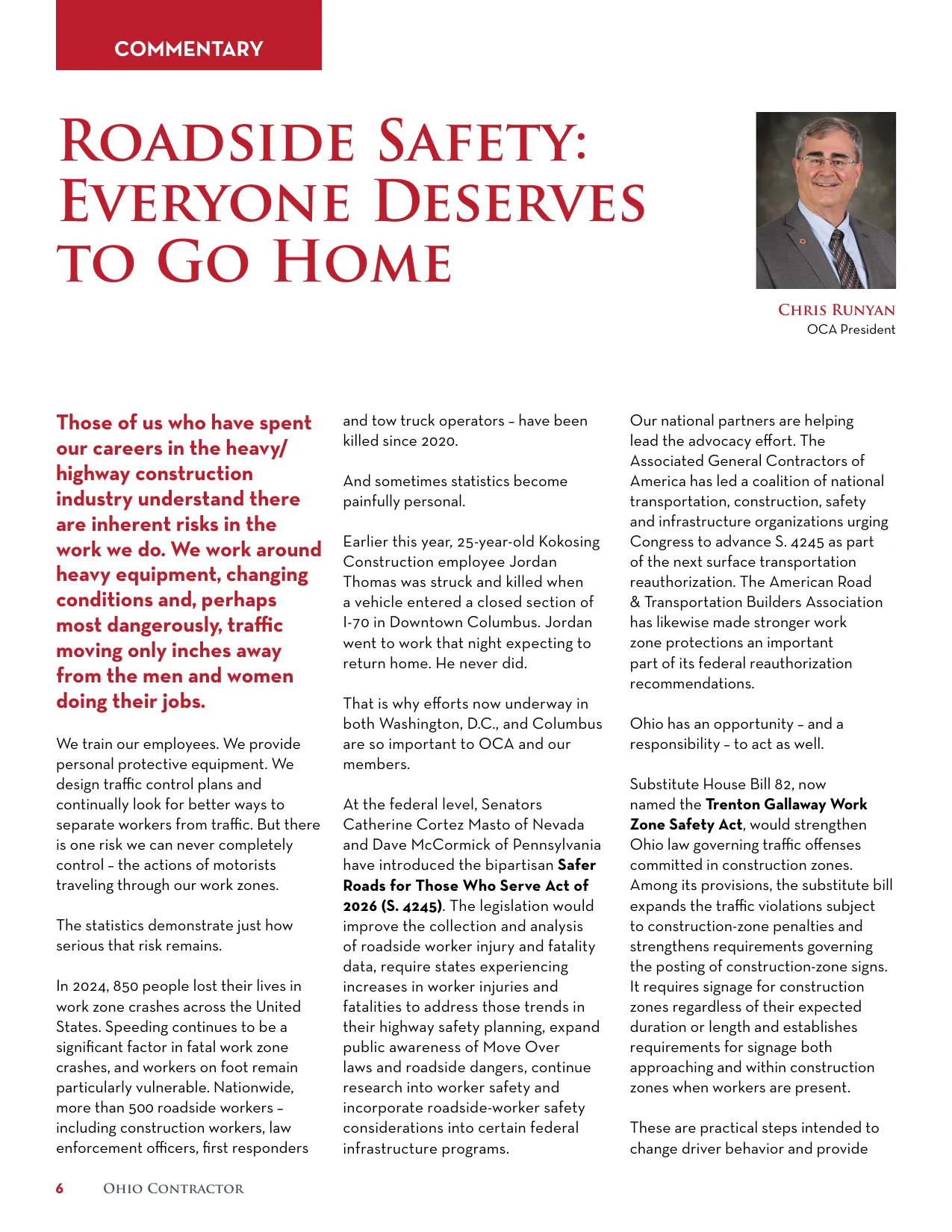
Chris Runyan
OCA President
and tow truck operators – have been killed since 2020.
And sometimes statistics become painfully personal.
Earlier this year, 25-year-old Kokosing Construction employee Jordan Thomas was struck and killed when a vehicle entered a closed section of I-70 in Downtown Columbus. Jordan went to work that night expecting to return home. He never did.
Our national partners are helping lead the advocacy effort. The Associated General Contractors of America has led a coalition of national transportation, construction, safety and infrastructure organizations urging Congress to advance S. 4245 as part of the next surface transportation reauthorization. The American Road & Transportation Builders Association has likewise made stronger work zone protections an important part of its federal reauthorization recommendations.
Those of us who have spent our careers in the heavy/ highway construction industry understand there are inherent risks in the work we do. We work around heavy equipment, changing conditions and, perhaps most dangerously, traffic moving only inches away from the men and women doing their jobs.
Ohio has an opportunity – and a responsibility – to act as well.
That is why efforts now underway in both Washington, D.C., and Columbus are so important to OCA and our members.
We train our employees. We provide personal protective equipment. We design traffic control plans and continually look for better ways to separate workers from traffic. But there is one risk we can never completely control – the actions of motorists traveling through our work zones.
The statistics demonstrate just how serious that risk remains.
Substitute House Bill 82, now named the Trenton Gallaway Work Zone Safety Act, would strengthen Ohio law governing traffic offenses committed in construction zones. Among its provisions, the substitute bill expands the traffic violations subject to construction-zone penalties and strengthens requirements governing the posting of construction-zone signs. It requires signage for construction zones regardless of their expected duration or length and establishes requirements for signage both approaching and within construction zones when workers are present.
In 2024, 850 people lost their lives in work zone crashes across the United States. Speeding continues to be a significant factor in fatal work zone crashes, and workers on foot remain particularly vulnerable. Nationwide, more than 500 roadside workers – including construction workers, law enforcement officers, first responders
These are practical steps intended to change driver behavior and provide
At the federal level, Senators Catherine Cortez Masto of Nevada and Dave McCormick of Pennsylvania have introduced the bipartisan Safer Roads for Those Who Serve Act of 2026 (S. 4245). The legislation would improve the collection and analysis of roadside worker injury and fatality data, require states experiencing increases in worker injuries and fatalities to address those trends in their highway safety planning, expand public awareness of Move Over laws and roadside dangers, continue research into worker safety and incorporate roadside-worker safety considerations into certain federal infrastructure programs.
6 Ohio Contractor
Page 7
greater protection to the men and women whose workplace happens to be alongside moving traffic.
have an obligation to do everything reasonably possible to protect their employees. But there comes a point where the construction barrel ends and personal responsibility begins. And drivers bear that responsibility.
believe the person speeding, texting or failing to pay attention is someone else. Or perhaps, as is too often the case in the legislative process, even issues on which there appears to be broad agreement must compete with hundreds of other priorities for attention.
And government has a responsibility to establish and enforce laws that recognize the extraordinary risk faced by people whose workplace is within inches of moving traffic.
Whatever the reason, none of those explanations is particularly satisfying when a family has lost a son, daughter, husband, wife, father or mother simply because they went to work alongside one of our highways.
The question should not be whether we can eliminate every work zone accident. We cannot. The question should be whether we have done everything reasonably within our power to prevent the next one.
OCA members have been directly involved in advocating for H.B. 82. During testimony before the House Public Safety Committee, representatives of our industry stood alongside organized labor, safety organizations and, most importantly, family members of workers who have paid the ultimate price. OCA Legislative Director Michelle Holdgreve testified in support of the legislation, as did representatives of OCA member companies. The committee ultimately reported the substitute bill favorably by a 10-0 vote.
That brings me to a question I have difficulty answering:
For the families who have already lost someone, legislation comes too late. For the thousands of men and women working behind the barrels today, it does not.
Why is passing legislation addressing roadside safety so difficult?
There will always be legitimate discussion about the details of legislation – what penalties are appropriate, how laws should be enforced and which safety measures will be most effective. That discussion is part of the legislative process. But disagreement over details should not prevent us from agreeing on the objective.
They should not have to lose another coworker before we decide their safety deserves our attention.
We can continue improving our training, traffic control, positive protection and technology such as speed enforcement cameras – and we must. Contractors
Perhaps part of the answer is that highway construction workers are largely invisible to the public until a motorist encounters a work zone. Perhaps it is because most drivers
7 2026 September/October
Page 8
GUEST COMMENTARY
When Transportation Funding Becomes an Election Issue
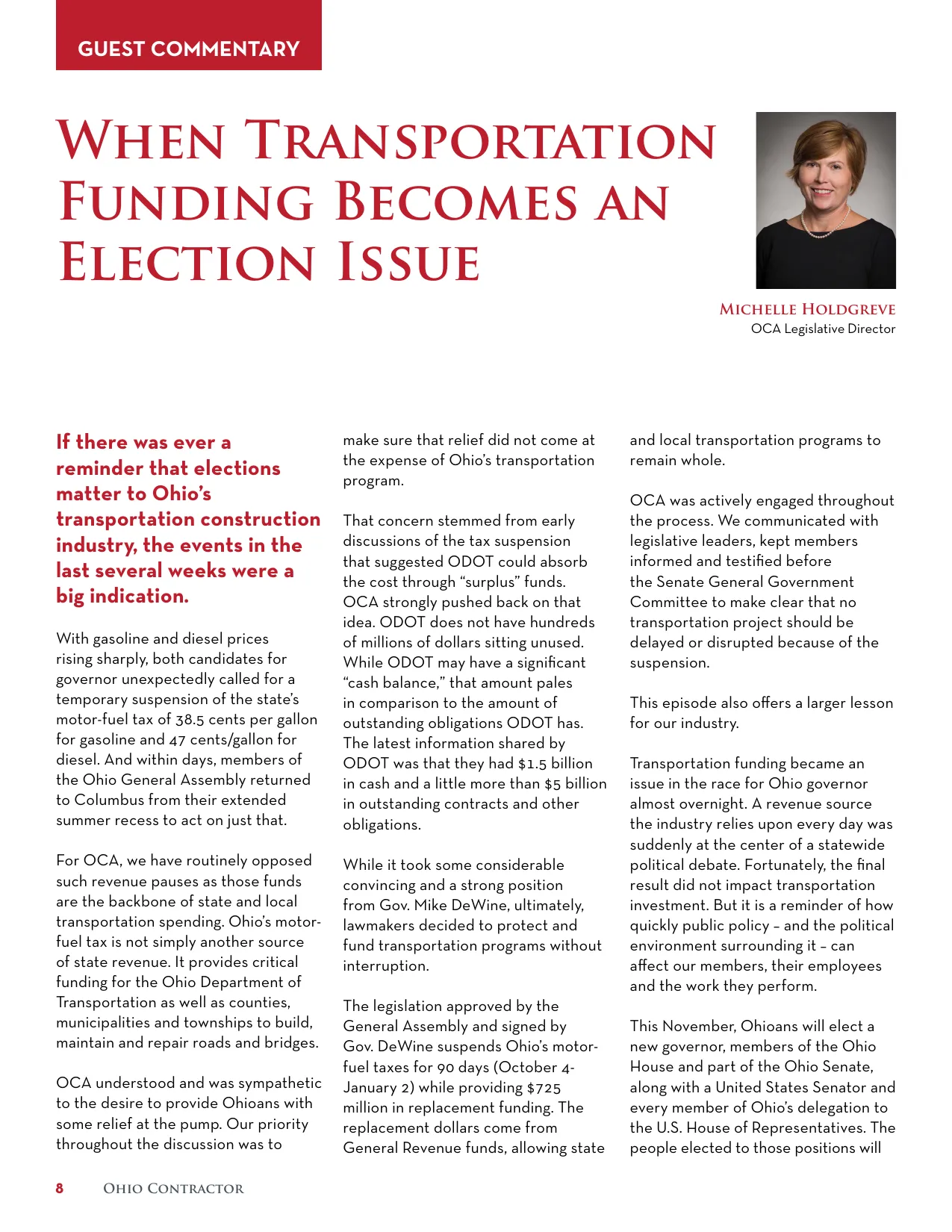
Michelle Holdgreve
OCA Legislative Director
and local transportation programs to remain whole.
make sure that relief did not come at the expense of Ohio’s transportation program.
If there was ever a reminder that elections matter to Ohio’s transportation construction industry, the events in the last several weeks were a big indication.
OCA was actively engaged throughout the process. We communicated with legislative leaders, kept members informed and testified before the Senate General Government Committee to make clear that no transportation project should be delayed or disrupted because of the suspension.
This episode also offers a larger lesson for our industry.
With gasoline and diesel prices rising sharply, both candidates for governor unexpectedly called for a temporary suspension of the state’s motor-fuel tax of 38.5 cents per gallon for gasoline and 47 cents/gallon for diesel. And within days, members of the Ohio General Assembly returned to Columbus from their extended summer recess to act on just that.
That concern stemmed from early discussions of the tax suspension that suggested ODOT could absorb the cost through “surplus” funds. OCA strongly pushed back on that idea. ODOT does not have hundreds of millions of dollars sitting unused. While ODOT may have a significant “cash balance,” that amount pales in comparison to the amount of outstanding obligations ODOT has. The latest information shared by ODOT was that they had $1.5 billion in cash and a little more than $5 billion in outstanding contracts and other obligations.
While it took some considerable convincing and a strong position from Gov. Mike DeWine, ultimately, lawmakers decided to protect and fund transportation programs without interruption.
Transportation funding became an issue in the race for Ohio governor almost overnight. A revenue source the industry relies upon every day was suddenly at the center of a statewide political debate. Fortunately, the final result did not impact transportation investment. But it is a reminder of how quickly public policy – and the political environment surrounding it – can affect our members, their employees and the work they perform.
For OCA, we have routinely opposed such revenue pauses as those funds are the backbone of state and local transportation spending. Ohio’s motorfuel tax is not simply another source of state revenue. It provides critical funding for the Ohio Department of Transportation as well as counties, municipalities and townships to build, maintain and repair roads and bridges.
OCA understood and was sympathetic to the desire to provide Ohioans with some relief at the pump. Our priority throughout the discussion was to
This November, Ohioans will elect a new governor, members of the Ohio House and part of the Ohio Senate, along with a United States Senator and every member of Ohio’s delegation to the U.S. House of Representatives. The people elected to those positions will
The legislation approved by the General Assembly and signed by Gov. DeWine suspends Ohio’s motorfuel taxes for 90 days (October 4- January 2) while providing $725 million in replacement funding. The replacement dollars come from General Revenue funds, allowing state
8 Ohio Contractor
Page 9
Ohio Secretary of State Voter Lookup website at: https://voterlookup. ohiosos.gov/voterlookup.aspx
make decisions about transportation funding, workforce issues, economic development and many other policies that directly affect Ohio’s construction industry.
• Find your early voting location and hours, which can also be found at the Ohio Secretary of State website, at: https://www.ohiosos.gov/directories/ early-voting-locations
Regardless of party or candidate, OCA members should understand what is at stake, learn where the candidates stand on issues important to our industry – and most importantly, vote.
Ohio Secretary of State Voter Lookup
Early voting began October 6, and Election Day is November 3. Take a few minutes now to make your voting plan:
The events of the past few weeks demonstrated just how closely elections, public policy and transportation funding are connected. Our industry has a significant stake in the decisions made at the Statehouse. Make sure your voice is part of the process.
Early voting locations/ hours
• Check your voter registration and find your Election Day polling location, which can be found at the
Our Services
• Construction Site SWPPP • Erosion Control Inspections • Temporary Access Fill Design • Drone Services • Civil Engineering Consulting
CESSWI
Jennifer E. Deaton, CPESC, CESSWI Kristin Holland, P.E., CPESC
Our Quality and Service is Unmatched Since 1978
CUSTOMIZED TRAINING Earn CPESC & CESSWI PDH’s On-site at your facility or in the field
CUSTOMIZED TRAINING Earn CPESC & CESSWI PDH’s On-site at your facility or in the field
Asphalt Planing Micro Milling Fine Milling Excavation – Up to 16.5” Bridge Deck Scarification Type 2 Rumble Strips Diamond Grinding & Grooving
com
www.coyleswppp.com
BOCA Construction, Inc. 380 Eastpark Drive, Norwalk, Ohio 44857 Offfice (419) 668-5575 An Equal Opportunity Employer
WEST CHESTER - CORPORATE • (513) 942-2333 8366 Princeton Glendale Rd. Suite B4 | West Chester, OH 45069
Akron 2108 Braewick Circle, Suite 302, Akron, OH 44313
Visit www.bocaconstructioninc.com for more on our services, capabilities, and history
9 2026 September/October
Page 10
FEATURE
FEATURE
FEATURE
FEATURE
OHIO’S RACE FOR GOVERNOR ACTON, RAMASWAMY VYING TO BECOME STATE’S 71st LEADER
Candidates’ Name Recognition Overshadows Political Experience
VIVEK RAMASWAMY (R)
AMY ACTON (D)
Page 11
begin serving in the U.S. Senate.
Let’s learn more about Ohio’s 2026 gubernatorial candidates and their running mates:
Despite neither having been elected to public office, Ohio’s main gubernatorial candidates in the 2026 election are well recognized at the state and national levels.
November’s election to decide Ohio’s 71st governor matches Democrat Amy Acton, who served as the state’s Health Director during the COVID-19 pandemic, against Republican Vivek Ramaswamy, who has been a national figure since his anti-woke corporate messages in 2021 and his run for U.S. President in the 2024 election.
Ohio is one of 36 states selecting their next governor on November 3. Those states choosing their next state leader are currently divided at 18 Democratic and 18 Republican governors. According to Ballotpedia, entering the 2026 election there are 26 states administered by Republican governors and 24 guided by Democratic governors.
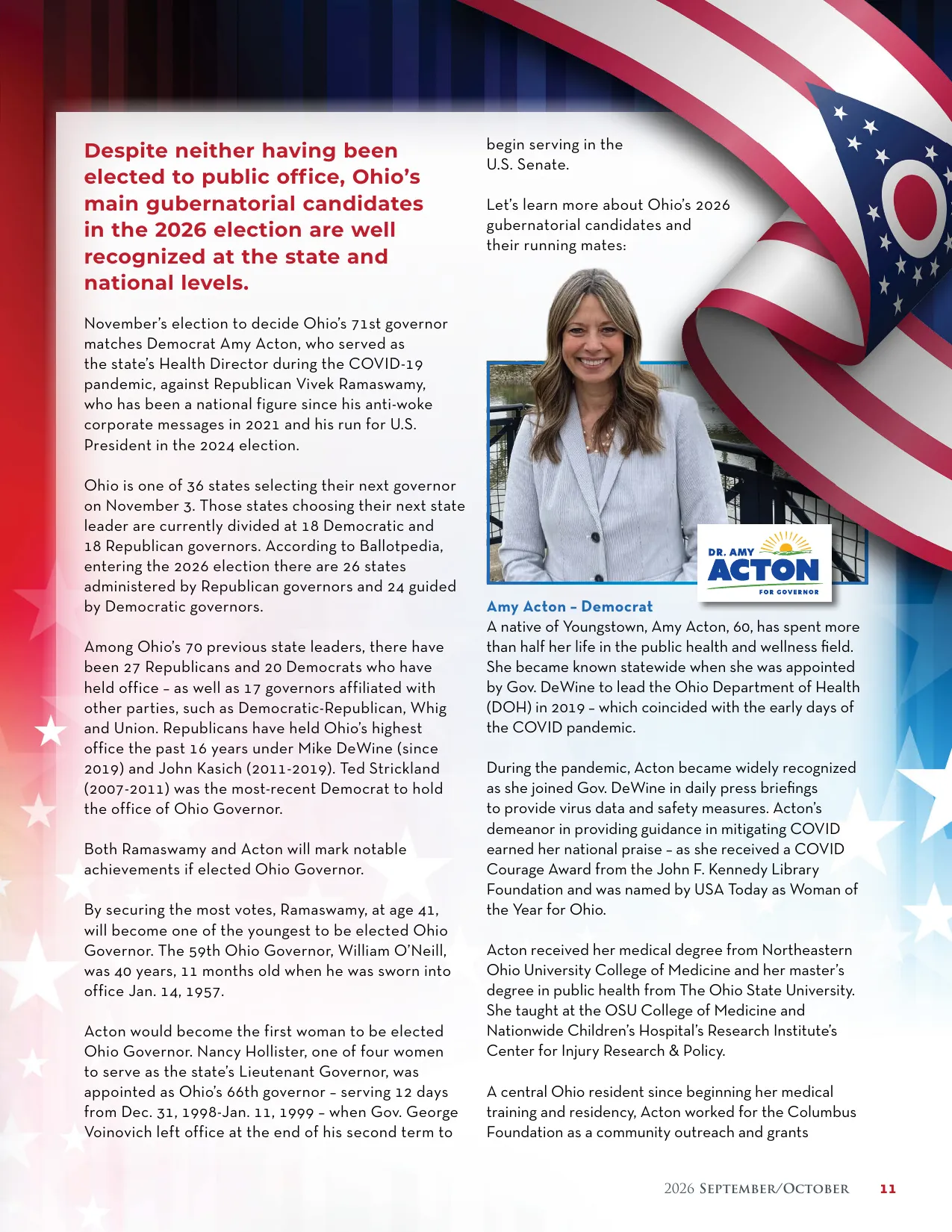
Amy Acton – Democrat A native of Youngstown, Amy Acton, 60, has spent more than half her life in the public health and wellness field. She became known statewide when she was appointed by Gov. DeWine to lead the Ohio Department of Health (DOH) in 2019 – which coincided with the early days of the COVID pandemic.
Among Ohio’s 70 previous state leaders, there have been 27 Republicans and 20 Democrats who have held office – as well as 17 governors affiliated with other parties, such as Democratic-Republican, Whig and Union. Republicans have held Ohio’s highest office the past 16 years under Mike DeWine (since 2019) and John Kasich (2011-2019). Ted Strickland (2007-2011) was the most-recent Democrat to hold the office of Ohio Governor.
Both Ramaswamy and Acton will mark notable achievements if elected Ohio Governor.
During the pandemic, Acton became widely recognized as she joined Gov. DeWine in daily press briefings to provide virus data and safety measures. Acton’s demeanor in providing guidance in mitigating COVID earned her national praise – as she received a COVID Courage Award from the John F. Kennedy Library Foundation and was named by USA Today as Woman of the Year for Ohio.
By securing the most votes, Ramaswamy, at age 41, will become one of the youngest to be elected Ohio Governor. The 59th Ohio Governor, William O’Neill, was 40 years, 11 months old when he was sworn into office Jan. 14, 1957.
Acton received her medical degree from Northeastern Ohio University College of Medicine and her master’s degree in public health from The Ohio State University. She taught at the OSU College of Medicine and Nationwide Children’s Hospital’s Research Institute’s Center for Injury Research & Policy.
A central Ohio resident since beginning her medical training and residency, Acton worked for the Columbus Foundation as a community outreach and grants
Acton would become the first woman to be elected Ohio Governor. Nancy Hollister, one of four women to serve as the state’s Lieutenant Governor, was appointed as Ohio’s 66th governor – serving 12 days from Dec. 31, 1998-Jan. 11, 1999 – when Gov. George Voinovich left office at the end of his second term to
11 2026 September/October
Page 12
Squire Sanders Boggs and Blank Rome, he focuses his practice on commercial, business and appellate litigation.
management officer from 2017 until joining the DeWine Administration. Among the Foundation’s focuses are combating youth homelessness and enhancing women’s health.
He entered public office on his first try – winning a seat on Cincinnati City Council and serving from 2001-05. Over the next 10 years, Pepper served on the Hamilton County Commission – including as president from 2009-2010; ran for Ohio Auditor and Ohio Attorney General in 2010 and 2014, respectively; and was elected Ohio Democratic Party Chair – serving from 2015-2021.
A fiction and political writer, Pepper has authored several novels and is an adjunct professor teaching classes in election and voting rights at the University of Cincinnati School of Law.
Pepper and his wife, Alaina, have two children and reside in Cincinnati.
Following service as Ohio’s DOH Director, Acton returned to the Columbus Foundation and helped start its Center for Human Kindness, where she worked with CEOs, mayors and community advocates in promoting community health. She resigned from the Foundation in 2021 when she briefly considered running for the U.S. Senate.
Prior to announcing her run for governor in January 2025, Acton provided keynote addresses throughout Ohio and served as President/CEO of RAPID5 – a central Ohio non-profit focusing on wellness by connecting hiking and bike trails to water corridors.
Her gubernatorial campaign centers on affordability and supporting the working class, which includes medical debt, prescription costs and healthcare relief. In January, Acton selected David Pepper as her running mate.
Acton, who was uncontested in May’s primary, resides in Bexley with her husband, Eric, a public-school teacher. The couple has six children.
Vivek Ramaswamy – Republican A Cincinnati native, Vivek Ramaswamy, 41, has made a name for himself at the national level not only as a leading conservative voice but also in the biotech field.
David Pepper A fifth-generation Cincinnatian, David Pepper has worked as a lawyer, writer, political activist, elected official, adjunct professor and chair of the Ohio Democratic Party.
The Harvard University alumnus, where he graduated summa cum laude in biology, began his career as a biotech investor. Prior to turning 30, Ramaswamy had added a law degree from Yale University and became Founder/Executive Chairman of Roivant Sciences – a biopharmaceutical company. Along with leading large biotech initial public offerings (IPOs), the firstgeneration American was featured on the Forbes cover at age 30 due to his work in drug development.
Pepper, 55, graduated magna cum laude from Yale University and earned his juris doctorate from Yale Law School. Working as an attorney with Cincinnati law firms
12 Ohio Contractor
Page 13
Ramaswamy became well-known outside the biotech field in the 2020s. Leading up to him writing New York Times bestseller “Woke, Inc.,” he was recognized as a “prominent national commentator on stakeholder capitalism, free speech and work culture.”
Prior to his political career, which began in the Ohio House of Representatives in 2015, McColley worked with the Community Improvement Corporation of Henry County, where he oversaw economic development and worked to improve workforce development among manufacturers and high school students. Following two years in the Ohio House – where he was named Assistant Majority Whip, McColley was appointed to the Ohio Senate in 2017. Sen. McColley has served in the Ohio Senate for nine years. Reelected in 2024, Sen. McColley was unanimously selected Ohio Senate President in January 2025.
McColley and his wife, Denise, have three children and reside in Napoleon.
While he initially considered representing Ohio by running for U.S. Senate in 2022, his first political run came in 2023. Ramaswamy ran as the youngest presidential candidate in the 2024 Republican primaries – appearing in five national debates. Though he dropped out of the presidential race, Ramaswamy impressed on the national stage. His support of Donald Trump led him to briefly serve as a co-leader for the Department of Government Efficiency (DOGE) – which was tasked with cutting wasteful federal spending.
Ramaswamy, who brings a political message of lower taxes and improved education, healthcare, jobs and public safety, announced he was running for governor in February 2025 and selected Rob McColley as his running mate in January.
In May’s primary election, Ramaswamy earned the Republican nomination for governor by receiving 82.5% of the votes in defeating northwest Ohio business owner Casey Putsch.
Ramaswamy resides in the Columbus area with his wife, Apoorva, who is a throat surgeon at Arthur G. James Cancer Hospital and Richard J. Solove Research Institute at The Ohio State University as well as an assistant professor at OSU. The couple has three children.
Rob McColley In his more than a decade of government service in the Ohio House and Senate, Rob McColley has earned the confidence of both his constituents and fellow state legislators.
McColley, 42, majored in finance and graduated with a business degree from The Ohio State University and later earned his juris doctorate from the University of Toledo College of Law.
13 2026 September/October
Page 14
FEATURE
CLAIMS & FACTS REGARDING DATA CENTERS
CLAIMS & FACTS REGARDING DATA CENTERS
Ohio Among Leaders in Construction of Information Facilities
Ohio Among Leaders in Construction of Information Facilities
location making it both a transportation and commerce hub, the state is also becoming a home for data hubs. According to Data Center Geeks, as of August 2026, Ohio ranked among the top five states in the nation for data centers with 240 – trailing only Virginia (651), Texas (513), California (296) and Georgia (274).
With many more data centers being planned for construction – which according to the Office of Ohio’s Consumers’ Counsel could be an additional 80 coming to the state by 2030 – the state’s construction industry is joining economic development groups, chambers of commerce, policymakers, professional services, technology companies and others leaning toward the pro-data center sector.
Heading into November’s midterm elections, the political divide wasn’t necessarily whether you were Democrat or Republican but more along the dividing line of whether you were pro- or anti- data centers.
In September 2026, according to market intelligence company Cleanview, more than 1,300 data centers were operating in the U.S. – with more than 2,200 others being constructed or planned for construction. Cleanview specializes in tracking the nation’s development of power and data facilities.
Ohio leads the nation when it comes to data center-related ballot measures in the 2026 elections. While California, Florida, Illinois, Kansas, Michigan, Nevada and Wisconsin also are combining in the 38 ballot initiatives this year, Ohio will have 20 measures for voters to decide in November’s midterm elections. In June, Ohio’s Business Roundtable released “Data Centers in Ohio, Fact vs.
As Ohio is known for being “The Heart of it All” due to its geographic
A data center is a facility housing a centralized network of computers, servers and information storage. These large warehouse-looking facilities typically contain rows of computer servers, data storage systems and networking equipment, along with the power and cooling infrastructure needed to operate them. The number of data centers is increasing with growing use of digital technology, as every action – from movie streaming, sending emails, online shopping, training artificial intelligence models and more – relies on data center operations.
14 Ohio Contractor
Page 15
In addition, data center servers are on a 5- to 6-year replacement cycle, which “regenerates” construction work throughout the facility’s existence.
Fiction” to dispel claims from currentday NIMBY (not in my backyard) groups that “data centers consume staggering amounts of water, drive up residential electric bills, create few jobs, benefit from tax giveaways at residents’ expense” and more.
DATA ON
From 2016-2023, employment at Ohio data centers grew 70.5% – which was faster than the national rate of 60%. Forecasts show that the national employment in the areas of computing infrastructure providers, data processing, web hosting and related services will grow another 20.3% by 2034. A Great Lakes Data Center study by the University of Virginia estimates “Ohio data centers will add $4.7 billion in GDP and 37,200 jobs by 2030.
WATER
DATA CENTERS
Claim: Data centers consume millions of gallons of water per day and dump waste into nearby watersheds
Founded in 1992, the Ohio Business Roundtable’s mission is to improve the state’s business climate. A nonpartisan, nonprofit advocacy group, the Roundtable works with Ohio’s legislative leaders to make the state more business friendly and competitive nationally and internationally by addressing economic challenges and implementing policies to strengthen competitiveness. The organization consists of more than 120 company presidents/CEOs – of which more than one-third lead Fortune 1000 companies. (For more information, visit the group’s website at www.ohiobrt. com.)
• The U.S. is home to nearly 40% of the world’s data centers. Other nations among global leaders in data centers are: 2. United Kingdom, 3. Germany, 4. France and 5. China.
The Data Centers in Ohio, Fact vs. Fiction study looks at claims in eight areas that fuel the anti- and pro-data center debate: Jobs, Water, Energy, Property Tax & Abatements, School Districts, Sales Tax Incentives, Noise and Economic Impact.
Facts:The days of high-water use as a result of evaporative cooling used in data center designs are going to the wayside, as the broader industry is shifting to “closed-loop” and “directto-chip” liquid cooling methods. Microsoft, which operates more than 500 data centers across the world, has committed to going to a “zero-water evaporative closed-loop design” of its data centers by 2030.
Here is a look at each area’s “claims” and “facts” according to the report:
JOBS
• The first data center in the U.S. dates to 1945 with the Electronic Numerical Integrator and Computer (ENIAC) at the University of Pennsylvania in Philadelphia. Ohio’s first “data center” is believed to have been in the mid-1960s with the invention of a prototype air conditioner to regulate temperature/humidity for early IBM computing facilities.
Claim: Data centers don’t create jobs
• With the size being compared to a large big-box retail store, the average U.S. data center site is 225 acres, while “hyperscale facilities” can be on 1,000 acres or more.
• Since 2020 nearly half (46%) of private office construction in the U.S. has been for data centers.
Closed-loop data centers and other water-saving efforts are already planned and being used in Ohio. While data center adversaries claim multimillion gallon-per-day water usage, a 400,000-sf data center planned for New Albany will operate – after initial setup – on 30,000 gallons a day for restroom and kitchen use – which is comparable to the daily use of a fast-food restaurant. Recycled water programs for Ohio’s data centers are already being advanced as part of a statewide effort. Also, this year in Ohio, two state representatives introduced legislation tracking data center water usage.
Facts:The physical footprint of a data center is anywhere from 200,000 to 500,000 square feet. According to the report, a 250,000 square-foot data center requires 1,500-2,000 construction workers over the 12- to 18-month building period. Once online, data centers require an operating staff of 25-50 full-time employees and an additional staff of 25-50 people providing security and maintenance.
15 2026 September/October
Page 16
Regarding the claim of data center waste dumping in watersheds, “most onsite cooling water is potable (i.e. safe for drinking) and recirculates through the loop; there is no industrial discharge stream comparable to chemical manufacturing and food processing.”
for a tax exemption, it must work with local economic development officials and JobsOhio prior to applying to the Ohio Tax Credit Authority. The Ohio Tax Credit Authority’s decision on whether a data center project receives full, partial or no exemption is determined through Ohio Department of Development guidance.
ENERGY
Facts: Real estate taxes on land cannot be deducted in Ohio. Land under data centers pay from Day 1 and continues to being paid for – even if there is an allowance in building taxes. during a building tax abatement. Data center buildings in central Ohio are appraised upwards of 375% more than the typical industrial or manufacturing building. The report also points out that “Ohio’s agricultural land is taxed far below market value” in the Current Agricultural Use program.
Claim:Data centers are driving up electricity bills for Ohio residents and putting the cost of new generation onto everyday ratepayers.
SCHOOL DISTRICTS
Claim:Data centers strain school districts and starve them of revenue.
It is ill-advised to believe data centers would continue to call Ohio home if the state did not provide tax incentives. Without exemptions, recurring property and income taxes, payment in lieu of taxes (PILOT), New Community Authorities (NCA) charges and payroll revenue would not benefit Ohioans due to future projects going to other states.
NOISE
Facts: While data centers are large electricity users – as Ohio’s data center demand is projected to double (5.3% to 11% of state demand) by 2030 – state and national initiatives would help shield residents and everyday ratepayers from rising energy costs.
Claim:Data centers are loud industrial sites that disturb neighborhoods at all hours.
Facts: The claim that data centers increase housing demand and headcount in school districts is unfounded, as data centers have low employment headcount per square foot. So, they do not produce the housing demand or enrollment growth that residential development or manufacturing development does. All revenue flowing in from data centers to schools is without offsetting costs.
In Ohio, the Public Utilities Commission of Ohio (PUCO) approved the AEP Ohio Data Center Tariff in July 2025, which requires data centers using more than 25 megawatts of electricity “to pay for 85% of contracted capacity for 12 years even if they use less.” In addition, “exit penalties” equal to three years of minimum charges have also been implemented for data center owners as additional ways to protect residential ratepayers.
Data centers are also proving to be good stewards, as owners are funding direct school programming – such as science, technology, engineering and mathematics (STEM) events, Space Nights and other certification pathway programs.
Facts: Noise levels from data centers range from 60 decibels – about the sound level of normal conversation or a window air conditioner – to 90 decibels – the sound level of a gas-powered lawnmower or hairdryer. The high-end sound level of a data center can be traced usually to facilities built prior to updated noise mitigation actions that include equipment-level acoustic treatment and within modern Ohio zoning and design reviews.
SALES TAX INCENTIVES
At the national level, the White House Ratepayer Protection Pledge was implemented this March, which requires “hyperscalers” (large-scale cloud service providers) and AI companies to “build, bring or buy the energy they need” in order to protect American consumers from price hikes attributed to data center infrastructure.
Ohio communities are building noise mitigation into their zoning approvals for data centers. So, many data center noise complaints “typically stem from absent or weak local ordinances – not from the technology itself.”
Claim:Ohio’s data center sales tax exemption is an unjustified $141 millionper-year giveaway. Without exemption, the data centers would still come.
ECONOMIC IMPACT
PROPERTY TAX & ABATEMENTS
Facts: Attracting data centers to a state or region is competitive. While Ohio is one of 36 states having a data center sales tax exemption, it is one of only a few where it is not automatic. For an Ohio data center developer to qualify
Claim: Data centers create no real economic value. They take farmland, drain utilities and leave little behind for the community.
Claim: Data centers don’t pay property taxes – they receive 100% abatements that shift the tax burden onto residents.
16 Ohio Contractor
Page 17
According to the Roundtable report: “The data centers Ohio has attracted are not a self-contained economic prize; they are the substrate on which the next generation of Ohio’s broader corporate growth will be built.”
When it comes to the state being at the heart of it all with its growing inventory of data centers, the Ohio Business Roundtable writes: “Ohio is not at a crossroads – it is at a launching pad. The infrastructure, the investment and the momentum are already here. The only question now is how much of the future Ohio is ready to claim.”
When it comes to AI and “cloud economy,” location matters. According to the Ohio Business Roundtable report: “… Physical proximity to data centers is itself an economic asset.” Latency – which is the time it takes, usually measured in milliseconds, between a user’s action and a system’s response – is critical in AI computing. Companies are relocating their headquarters, research and development and digital operations near “clusters” of data centers to decrease what is referred to as the “latency penalty.”
Facts: In a little more than a decade, Amazon Web Services (AWS) has invested nearly $40 billion into Ohio through data center construction and operations – including almost $17 billion more than it initially committed. In one county alone, the AWS venture has meant a $4.1 billion total investment that has resulted in $645 million in GDP contributions and more than 2,350 full-time jobs. In addition to communities having the ability to capture revenue beyond conventional property tax (see sales tax incentive section), data centers “catalyze” further development and can bring utility and road infrastructure investments benefiting subsequent projects in the same corridor.
Often overlooked is the level of recurring revenue from construction income tax, as the city collects municipal income tax on those wages.
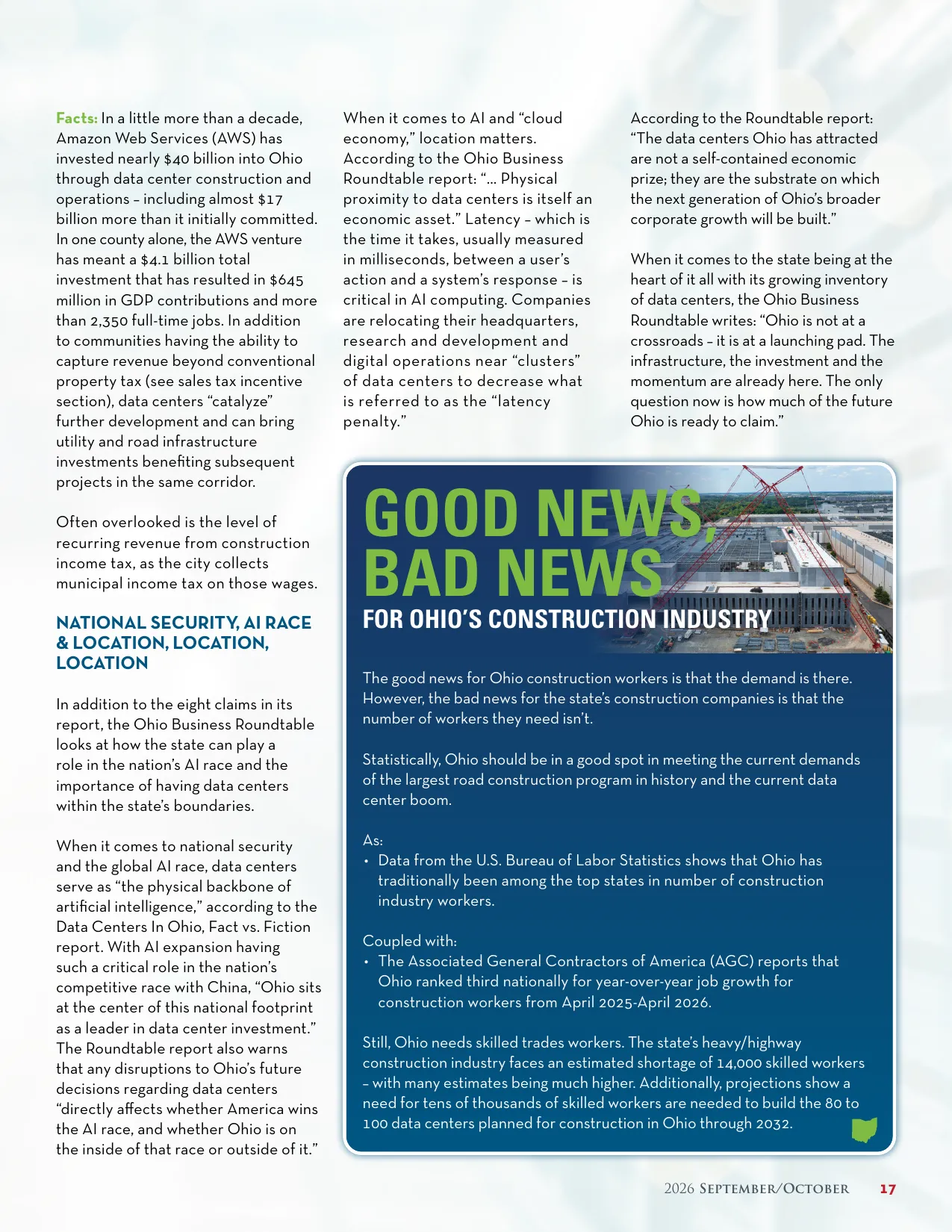
GOOD NEWS, BAD NEWS FOR OHIO’S CONSTRUCTION INDUSTRY
NATIONAL SECURITY, AI RACE & LOCATION, LOCATION, LOCATION
The good news for Ohio construction workers is that the demand is there. However, the bad news for the state’s construction companies is that the number of workers they need isn’t.
Statistically, Ohio should be in a good spot in meeting the current demands of the largest road construction program in history and the current data center boom.
In addition to the eight claims in its report, the Ohio Business Roundtable looks at how the state can play a role in the nation’s AI race and the importance of having data centers within the state’s boundaries.
As: • Data from the U.S. Bureau of Labor Statistics shows that Ohio has traditionally been among the top states in number of construction industry workers.
Coupled with: • The Associated General Contractors of America (AGC) reports that Ohio ranked third nationally for year-over-year job growth for construction workers from April 2025-April 2026.
Still, Ohio needs skilled trades workers. The state’s heavy/highway construction industry faces an estimated shortage of 14,000 skilled workers – with many estimates being much higher. Additionally, projections show a need for tens of thousands of skilled workers are needed to build the 80 to 100 data centers planned for construction in Ohio through 2032.
When it comes to national security and the global AI race, data centers serve as “the physical backbone of artificial intelligence,” according to the Data Centers In Ohio, Fact vs. Fiction report. With AI expansion having such a critical role in the nation’s competitive race with China, “Ohio sits at the center of this national footprint as a leader in data center investment.” The Roundtable report also warns that any disruptions to Ohio’s future decisions regarding data centers “directly affects whether America wins the AI race, and whether Ohio is on the inside of that race or outside of it.”
17 2026 September/October
Page 18
FEATURE
For Ohioans, Benefits from IHS are of ‘Epic Proportions’
However, Report Finds Assets of 70-year-old System are Diminishing
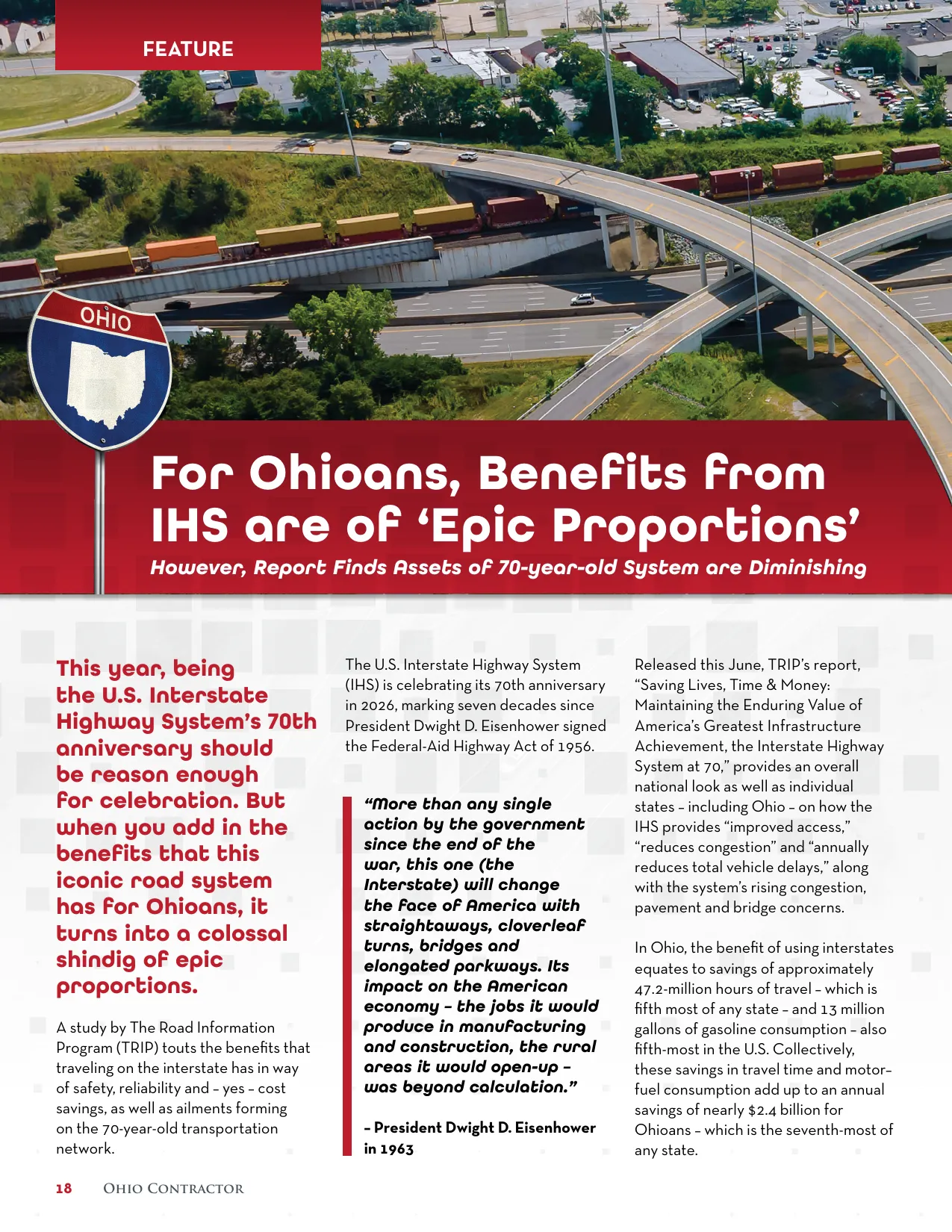
The U.S. Interstate Highway System (IHS) is celebrating its 70th anniversary in 2026, marking seven decades since President Dwight D. Eisenhower signed the Federal-Aid Highway Act of 1956.
Released this June, TRIP’s report, “Saving Lives, Time & Money: Maintaining the Enduring Value of America’s Greatest Infrastructure Achievement, the Interstate Highway System at 70,” provides an overall national look as well as individual states – including Ohio – on how the IHS provides “improved access,” “reduces congestion” and “annually reduces total vehicle delays,” along with the system’s rising congestion, pavement and bridge concerns.
This year, being the U.S. Interstate Highway System’s 70th anniversary should be reason enough for celebration. But when you add in the benefits that this iconic road system has for Ohioans, it turns into a colossal shindig of epic proportions.
“More than any single action by the government since the end of the war, this one (the Interstate) will change the face of America with straightaways, cloverleaf turns, bridges and elongated parkways. Its impact on the American economy – the jobs it would produce in manufacturing and construction, the rural areas it would open-up – was beyond calculation.”
– President Dwight D. Eisenhower in 1963
A study by The Road Information Program (TRIP) touts the benefits that traveling on the interstate has in way of safety, reliability and – yes – cost savings, as well as ailments forming on the 70-year-old transportation network.
In Ohio, the benefit of using interstates equates to savings of approximately 47.2-million hours of travel – which is fifth most of any state – and 13 million gallons of gasoline consumption – also fifth-most in the U.S. Collectively, these savings in travel time and motor– fuel consumption add up to an annual savings of nearly $2.4 billion for Ohioans – which is the seventh-most of any state.
18 Ohio Contractor
Page 19
What Makes a Highway an Interstate?
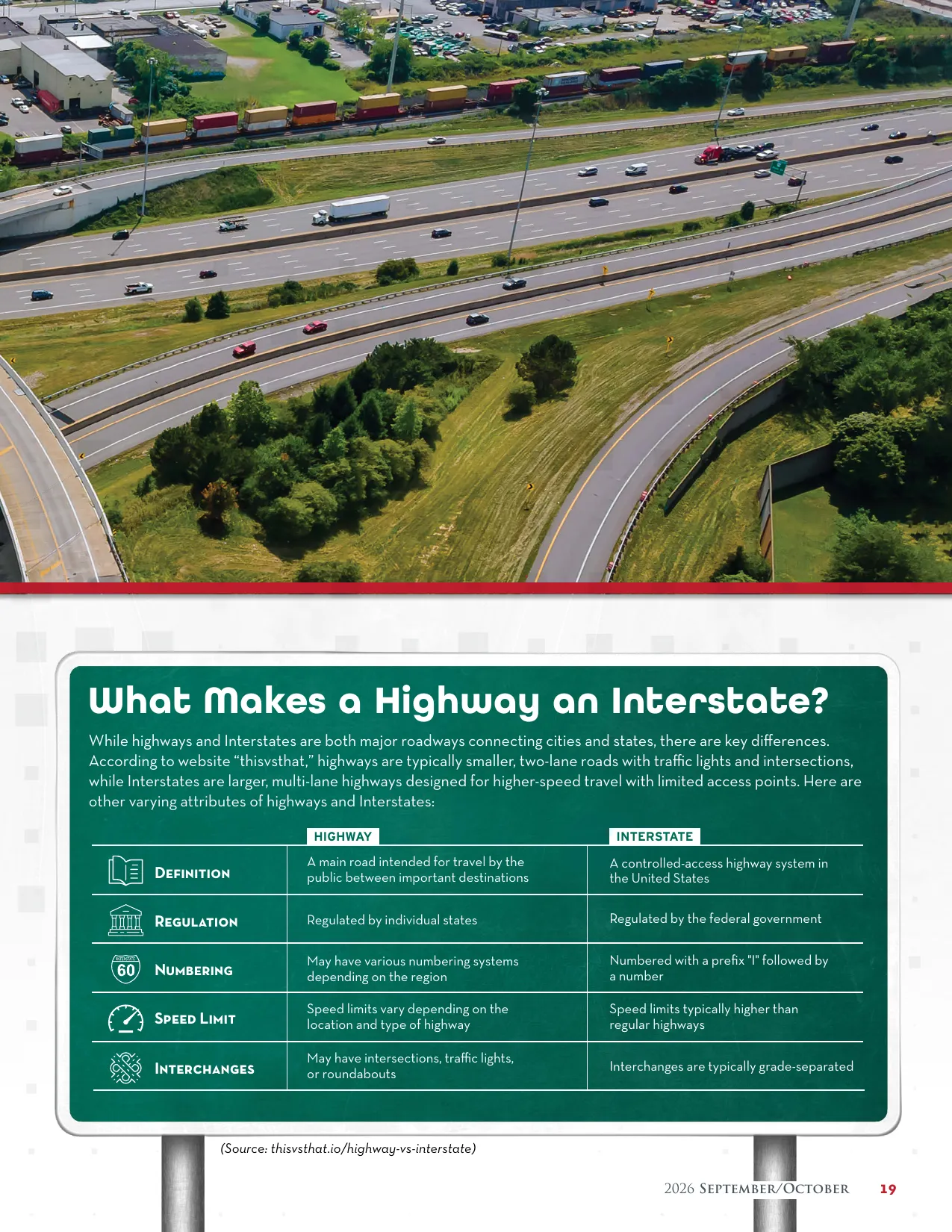
While highways and Interstates are both major roadways connecting cities and states, there are key differences. According to website “thisvsthat,” highways are typically smaller, two-lane roads with traffic lights and intersections, while Interstates are larger, multi-lane highways designed for higher-speed travel with limited access points. Here are other varying attributes of highways and Interstates:
HIGHWAY INTERSTATE
Definition
A main road intended for travel by the public between important destinations A controlled-access highway system in the United States
Regulated by individual states Regulated by the federal government
Regulation
Numbering
May have various numbering systems depending on the region Numbered with a prefix "I" followed by a number
Speed Limit
Speed limits vary depending on the location and type of highway Speed limits typically higher than regular highways
Interchanges May have intersections, traffic lights, or roundabouts Interchanges are typically grade-separated
(Source: thisvsthat.io/highway-vs-interstate)
19 2026 September/October
Page 20
TRIP is a national transportation research nonprofit based in Washington, D.C.
to 1.22 on non-interstate routes.” This reduction in accidents is estimated to not only save lives but also provide Ohio with an annual economic benefit of $1.1 billion due to fewer serious and fatal traffic crashes.
Along with savings at the gas pump, the nation’s 46,876-mile interstate system provides an estimated $65 billion annual benefit because of improved traffic safety and reduced traffic congestion. The TRIP report (tripnet.org/reports/ americas-interstate-highway-systemat-70-2026) highlights:
The first “interstate route” in Ohio was a 12.4-mile-long portion of I-280, which was built from 1955-1959, which today serves as a connector of I-75 to I-80/I-90 southeast of Toledo in Wood County. I-280 was originally part of the Detroit-Toledo Expressway.
More efficient and reliable travel on Ohio’s Interstate routes provides a $1.3 billion benefit to the state because of reduced delays and fuel consumption.
• Travel on the nation’s Interstate highways is nearly two-and-a-half times safer than travel on all other roadways due to improved roadway safety features resulting in an annual benefit of $28 billion in reduced costs because of fewer serious/fatal traffic crashes.
• The IHS reduces traffic congestion by providing more efficient/reliable travel, which provides $37 billion annually in benefits due to reduced delays and fuel consumption.
Ohio’s more than 1,500 miles of interstate ranks fifth-most of any state, including Texas with 3,233 miles, California (2,456), Illinois (2,169) and Pennsylvania (1,759). Ohio’s 1,572 IHS miles includes portions of nine primary routes – I-70, I-71, I-74, I-75, I-76, I-77, I-79, I-80 and I-90 – and 13 auxiliary/ spur routes – I-270, I-271, I-275, I-277, I-280, I-470, I-471, I-475, I-480, I-490, I-670, I-675 and I-680 – which as a whole provide safer travel compared to the state’s other roadways systems.
Too Much of A Good Thing While the IHS provides a $65 billion annual benefit to the U.S., its increasing use is unfortunately becoming more and more a liability. In its study, TRIP looks at the Transportation Research Board’s (TRB) report to Congress that found the interstate system is heavily congested and aging. “According to the 2019 TRB Report,” TRIP writes, “the Interstate System has a persistent and growing backlog of physical and operational deficiencies as a result of age, heavy use and deferred investment, and is in need of major reconstruction and modernization.”
For More Information www.TheMcLeanCompany.com
Ohio’s interstate travel from 2000-2024 grew 15% – which was much less than the nation’s interstate VMT of 29% in that five-year span – however, nearly half (47%) of Ohio's urban interstate system is considered congested during peak hours. TRIP reports that the Interstate System includes “2.6% of all roadway lane miles in the U.S., (but) carries 24% of the nation’s vehicle travel.” It adds that over the IHS’s 70 years of service, the nation’s VMT has increased 426%.
Why Choose Us
Our Customers Locations to Serve
Expert Support
Hudson
Quick Turnaround
Affordable Solutions
6681 Chittenden Road Hudson, OH 44236 330-655-5900
Columbus
Flexible Rental Plans
3155 E. 17 Avenue th
Columbus, OH 43219 614-475-2880
Cincinnati
www.LeeBoy.com
8131 Regal Lane West Chester, OH 45069 513-777-5556
According to TRIP, as a result of the interstate system’s “built-insafety features like median barriers, paved shoulders, a minimum of four lanes and complete separation from cross traffic and rail lines,” an estimated 263 lives were saved in Ohio in 2024. Regarding Ohio’s interstates saving the eighth-most lives of any state, TRIP writes: “The fatality rate, per 100-million vehicle miles of travel (VMT) on Ohio’s Interstate highways in 2024 was 0.46, compared
Continual travel on the IHS is impacting pavement and bridge conditions. TRIP reports that 9% of Ohio’s Interstate pavement was considered in poor/ mediocre condition (tying for 26th in the nation), while 2% of its IHS bridges were rated in “poor” condition (tied for 20th lowest in the U.S.).
20 Ohio Contractor
Page 21
is absolutely vital that we preserve these transportation benefits for future generations of Americans, but this will require that the funding needed to rebuild and modernize our Interstate highways is provided.”
The IHS’s Road Ahead “… The Interstate Highway System,” according to TRIP, “is suffering from severe wear and escalating congestion. To meet future demands, the system urgently requires sweeping modernization, capacity expansion and foundational reconstruction.
Infrastructure Investment and Jobs Act (IIJA), expired September 30. With limited actions in passing a successor to IIJA, the current transportation program has been extended through a short-term continuing resolution by Congress to December 11.
TRIP’s discussion of IHS reconstruction, expansion and modernization is timely, considering the work going on in Congress on the next federal transportation program. The current transportation program, the
Taft/Law
Since 1885
Serving The Construction Industry
n
“… While pavement smoothness on most segments of the Interstate system is acceptable, the crumbling foundations of most highway segments need to be reconstructed, and that continued resurfacing – rather than addressing underlying foundational issues – is resulting in diminishing returns and results in shorter periods of pavement smoothness.” To meet the nation’s current and future IHS needs, TRIP referred to TRB’s recommendations, writing: “The TRB report concludes that the annual investment into the Interstate Highway System should be increased approximately two-and-half times, from $23 billion in 2018 to $57 billion annually over the next 20 years.”
n
n
Along with increased funding, TRIP’s IHS recommendations are:
n
n
n
n
n
n
n
n
n
Bob Dunlevey
Labor & Employment Workers’ Comp Defense OSHA Collective Bargaining Business Law Construction Claims/Contracts Litigation Arbritration Environmental Immigration Government Contracts Real Estate
(937) 641-1743
His "Knowledge of Your Industry"
Board Certified Specialist in Labor & Employment Law
• The foundational reconstruction of Interstate highways, bridges and interchanges • Improvement to roadway safety features • System right-sizing, including upgrading of some roadway corridors to Interstate standards • Adding needed additional highway capacity on existing routes • Adding additional corridors • Modifying some urban segments to maintain connectivity while remediating economic and social disruption
Makes the Difference!
www.taftlaw.com
“The Interstate Highway System at 70 continues to provide tremendous benefits to Americans, saving lives, time and money,” said TRIP Executive Director Dave Kearby. “It
21 2026 September/October
Page 22
PAUL PETERSON COMPANY
Your Trusted Choice in Tunneling for 65 Years
Family owned and operated, the leader in trenchless applications, including:
Tunneling • Auger Boring • Pipe Jacking Vertical Shaft • Pipe Hammering • Culvert Rehab Cellular Grouting • Design/Build
Keeping You SAFE Since 1932
Keeping You SAFE Since 1932
TRAFFIC SAFETY• FENCE• GUARDRAIL TRAFFIC SIGNS• WORK ZONE STRIPING
2216 Refugee Rd. Columbus, OH Equal Opportunity Employer
PPCO.NET 614.486.4375
614-444-0255 • capitoltunneling.com
STATE HIGHWAY SUPPLY, INC.
Road, Bridge, and Construction Materials
7672 Fishel Drive North Dublin, OH 43016 (p) 614-799-9811 (f) 614-799-9794
www.statehighwaysupply.com
22 Ohio Contractor
Page 23
FEATURE
ODOT's Bidding Results for State FY 2027
WINNING BIDS
Reported June 1- September 17, 2026
Here is statistical information on recent ODOT projects awarded by districts and contractor affiliation:
79 PROJECTS // $173.3 MILLION
SFY 2027 SUMMARY – JUNE 1 - SEPTEMBER 17, 2026
PROJECTS AWARDED BY CONTRACTOR AFFILIATION
AWARD DOLLARS BY CONTRACTOR AFFILIATION
Non-Member 31.1%
Non-Member 22.9%
OCA Member 68.9%
OCA Member 77.1%
PROJECTS AWARDED BY ODOT DISTRICT
AWARD DOLLARS BY ODOT DISTRICT
9
$11.9M
District 1
District 1
12
$17.5M
District 2
District 2
14
$14.1M
District 3
District 3
13
$34.1M
District 4
District 4
11
$23.9M
District 5
District 5
6
$11.8M
District 6
District 6
9
$29.9M
District 7
District 7
$23.7M
10
District 8
District 8
$20.6M
14
District 9
District 9
$25.4M
9
District 10
District 10
$9.6M
10
District 11
District 11
$80.6M
18
District 12
District 12
23 2026 September/October
23 2026 September/October
Page 24
NEWSMAKERS
OCA PRESIDENT AWARDED ARTBA’S NELLO TEER AWARD OCA President Chris Runyan was honored by the American Road & Transportation Builders Association (ARTBA) at its recent national convention with the Nello L. Teer Jr. Award.
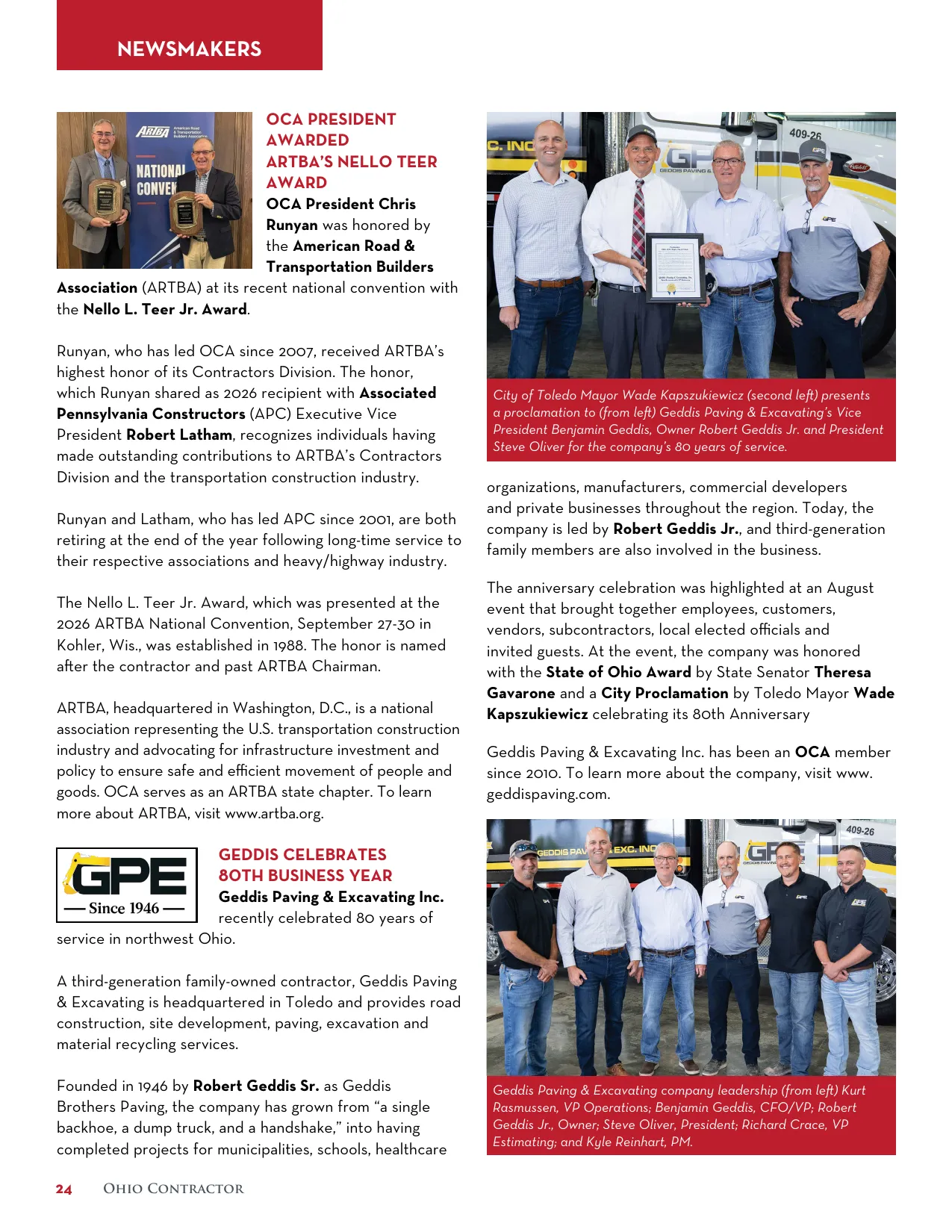
City of Toledo Mayor Wade Kapszukiewicz (second left) presents a proclamation to (from left) Geddis Paving & Excavating’s Vice President Benjamin Geddis, Owner Robert Geddis Jr. and President Steve Oliver for the company’s 80 years of service.
Runyan, who has led OCA since 2007, received ARTBA’s highest honor of its Contractors Division. The honor, which Runyan shared as 2026 recipient with Associated Pennsylvania Constructors (APC) Executive Vice President Robert Latham, recognizes individuals having made outstanding contributions to ARTBA’s Contractors Division and the transportation construction industry.
organizations, manufacturers, commercial developers and private businesses throughout the region. Today, the company is led by Robert Geddis Jr., and third-generation family members are also involved in the business.
Runyan and Latham, who has led APC since 2001, are both retiring at the end of the year following long-time service to their respective associations and heavy/highway industry.
The Nello L. Teer Jr. Award, which was presented at the 2026 ARTBA National Convention, September 27-30 in Kohler, Wis., was established in 1988. The honor is named after the contractor and past ARTBA Chairman.
The anniversary celebration was highlighted at an August event that brought together employees, customers, vendors, subcontractors, local elected officials and invited guests. At the event, the company was honored with the State of Ohio Award by State Senator Theresa Gavarone and a City Proclamation by Toledo Mayor Wade Kapszukiewicz celebrating its 80th Anniversary
Geddis Paving & Excavating Inc. has been an OCA member since 2010. To learn more about the company, visit www. geddispaving.com.
ARTBA, headquartered in Washington, D.C., is a national association representing the U.S. transportation construction industry and advocating for infrastructure investment and policy to ensure safe and efficient movement of people and goods. OCA serves as an ARTBA state chapter. To learn more about ARTBA, visit www.artba.org.
GEDDIS CELEBRATES 80TH BUSINESS YEAR Geddis Paving & Excavating Inc. recently celebrated 80 years of service in northwest Ohio.
A third-generation family-owned contractor, Geddis Paving & Excavating is headquartered in Toledo and provides road construction, site development, paving, excavation and material recycling services.
Geddis Paving & Excavating company leadership (from left) Kurt Rasmussen, VP Operations; Benjamin Geddis, CFO/VP; Robert Geddis Jr., Owner; Steve Oliver, President; Richard Crace, VP Estimating; and Kyle Reinhart, PM.
Founded in 1946 by Robert Geddis Sr. as Geddis Brothers Paving, the company has grown from “a single backhoe, a dump truck, and a handshake,” into having completed projects for municipalities, schools, healthcare
24 Ohio Contractor
Page 25
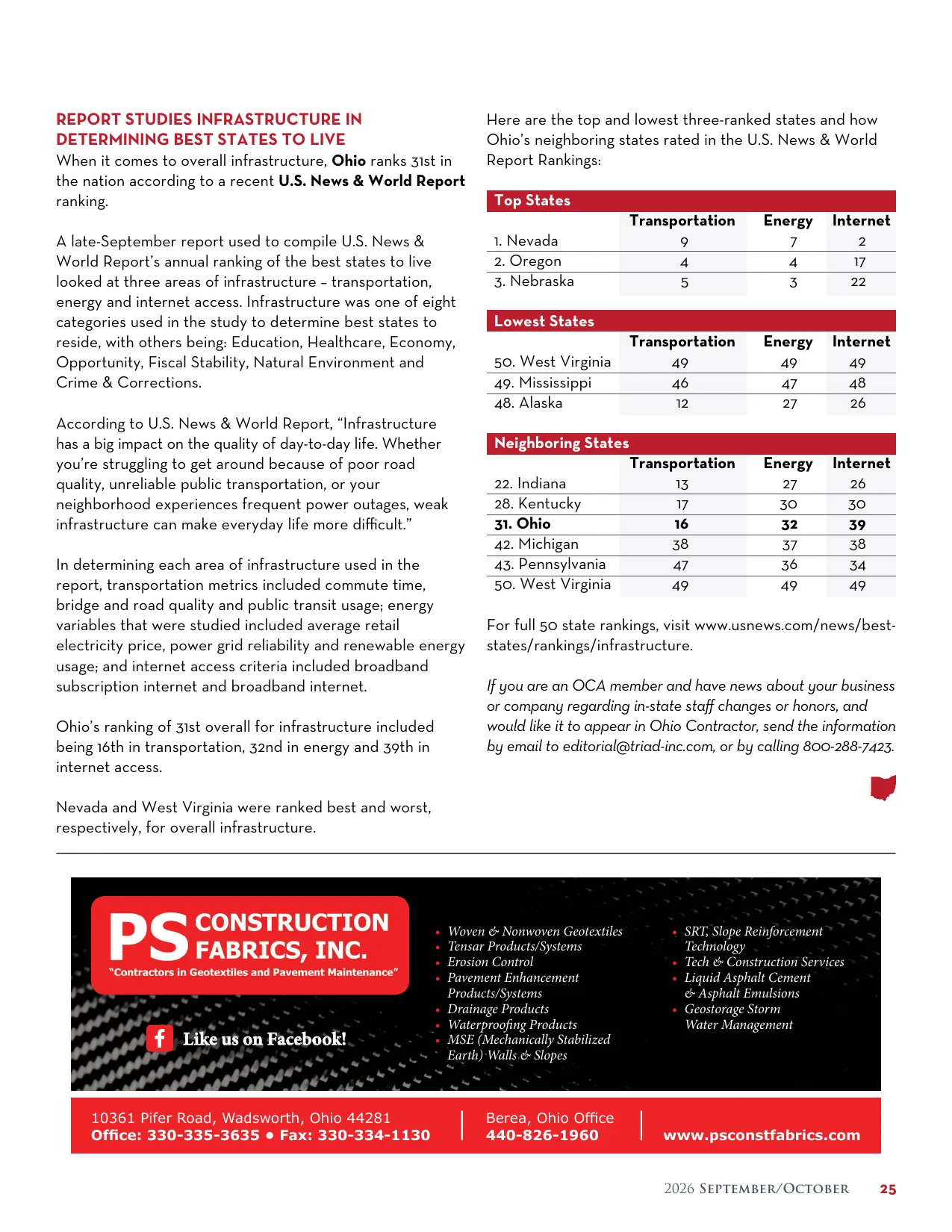
Here are the top and lowest three-ranked states and how Ohio’s neighboring states rated in the U.S. News & World Report Rankings:
REPORT STUDIES INFRASTRUCTURE IN DETERMINING BEST STATES TO LIVE When it comes to overall infrastructure, Ohio ranks 31st in the nation according to a recent U.S. News & World Report ranking.
Top States Transportation Energy Internet 1. Nevada 9 7 2 2. Oregon 4 4 17 3. Nebraska 5 3 22
A late-September report used to compile U.S. News & World Report’s annual ranking of the best states to live looked at three areas of infrastructure – transportation, energy and internet access. Infrastructure was one of eight categories used in the study to determine best states to reside, with others being: Education, Healthcare, Economy, Opportunity, Fiscal Stability, Natural Environment and Crime & Corrections.
Lowest States Transportation Energy Internet 50. West Virginia 49 49 49 49. Mississippi 46 47 48 48. Alaska 12 27 26
According to U.S. News & World Report, “Infrastructure has a big impact on the quality of day-to-day life. Whether you’re struggling to get around because of poor road quality, unreliable public transportation, or your neighborhood experiences frequent power outages, weak infrastructure can make everyday life more difficult.”
Neighboring States Transportation Energy Internet 22. Indiana 13 27 26 28. Kentucky 17 30 30 31. Ohio 16 32 39 42. Michigan 38 37 38 43. Pennsylvania 47 36 34 50. West Virginia 49 49 49
For full 50 state rankings, visit www.usnews.com/news/beststates/rankings/infrastructure.
In determining each area of infrastructure used in the report, transportation metrics included commute time, bridge and road quality and public transit usage; energy variables that were studied included average retail electricity price, power grid reliability and renewable energy usage; and internet access criteria included broadband subscription internet and broadband internet.
If you are an OCA member and have news about your business or company regarding in-state staff changes or honors, and would like it to appear in Ohio Contractor, send the information by email to editorial@triad-inc.com, or by calling 800-288-7423.
Ohio’s ranking of 31st overall for infrastructure included being 16th in transportation, 32nd in energy and 39th in internet access.
Nevada and West Virginia were ranked best and worst, respectively, for overall infrastructure.
• SRT, Slope Reinforcement Technology • Tech & Construction Services • Liquid Asphalt Cement & Asphalt Emulsions • Geostorage Storm Water Management
Like us on Facebook!
• Woven & Nonwoven Geotextiles • Tensar Products/Systems • Erosion Control • Pavement Enhancement Products/Systems • Drainage Products • Waterproofing Products • MSE (Mechanically Stabilized Earth) Walls & Slopes
10361 Pifer Road, Wadsworth, Ohio 44281 Office: 330-335-3635 • Fax: 330-334-1130 Berea, Ohio Office 440-826-1960 www.psconstfabrics.com
25 2026 September/October
Page 26
ADVERTISING INDEX
Asphalt Materials Inc. .......................................................5
Gallagher............................................................................BC
Ohio Cat.................................................................................2
BOCA Construction..........................................................9
The Gerken Companies.................................................26
Ohio Utilities Protection Service.................................3
Capitol Tunneling..............................................................22
The McLean Company.....................................................5
PS Construction Fabrics, Inc. .....................................25
Columbus Equipment Company..................................3
The McLean Company...................................................20
Paul Peterson Company................................................22
Coyle SWPPP Professionals..........................................9
Miller Bros. Const., Inc. ...................................................2
State Highway Supply/US Fabrics Inc. ....................22
JASA Aphalt Materials/Russell Standard Corp. .....7
Murphy Tractor & Equipment Companies..........IBC
Taft Stettinius & Hollister LLP.....................................21
26 Ohio Contractor
Page 27
GET MORE WITH MURPHY
SALES, RENTAL, PARTS AND SERVICE
murphytractor.com | 855-246-9124
Page 28
Ohio Contractor 1313 Dublin Road Columbus, Ohio 43215
PRESRT STD U.S. POSTAGE PAID COLUMBUS, OH PERMIT NO. 8755
Return Service Requested
AJG.com | The Gallagher Way. Since 1927.
Kyp Ross
kyp_ross@ajg.com
CONNECT WITH US Face tomorrow with confidence.
For nearly a century, we’ve been a trusted insurance, risk management and consulting
Mark Coleman
partner for businesses, communities and people around the globe. Customizing
mark_coleman@ajg.com
programs and solutions tailored to your needs. Driving better outcomes for your
people and your organization. Helping you build the confidence to handle whatever
Dave Black
comes next.
dave_black@ajg.com
Lou Colagrossi
lou_colagrossi@ajg.com
© 2026 Arthur J. Gallagher & Co., and affiliates & subsidiaries | GGBUS107552